'The Burnout Society' by Byung-Chul Han
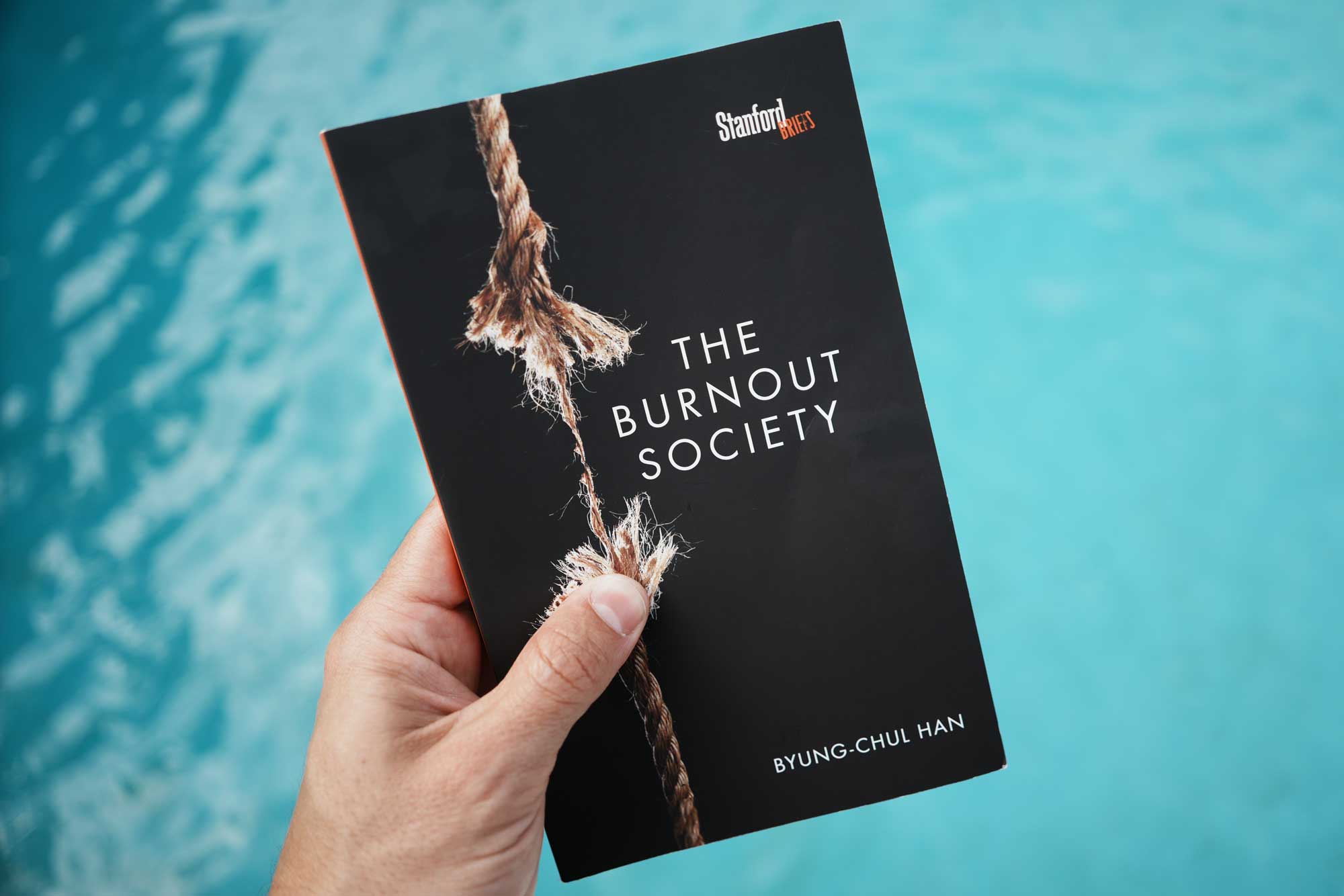
After reading and enjoying Byung-Chul Han’s short book The Disappearance of Rituals, I picked up more of the author’s books including what might be his most famous work, The Burnout Society.
Han’s book is a philosophical/sociological investigation into contemporary mental health issues like burnout, anxiety, and depression. Despite the book’s title title, it isn’t a true sociological inquiry. And despite its invoking of Freud and his ideas, the book doesn’t aim to help the individual overcome these issues. But it does contain some interesting perspectives of contemporary culture.
Han argues that contemporary society is an “achievement society” driven by projects, initiatives, and endless motivation. It emerged from a “disciplinary society,” which operated through the logic of “no” and “should.” On the other hand, contemporary achievement society seduces us with the promise of “yes” and “can.”
Because achievement society is optimistic and positive, and because it offers humans promise and potential, it is difficult for us to find fault in it. However, achievement society doesn’t represent liberation from discipline. Instead, it is a more insidious form of control, one in which we have paradoxically become our own masters and slaves.
Rather than being forced into productivity by an external authority (the model of discipline), Han argues that we now drive ourselves toward exhaustion under the guise of self-optimization, productivity, and personal achievement. The result is what Han terms “burnout.” From what I can gather, Han defines “burnout” as an exhaustion that emerges from depression and endless self-fashioning in a world stripped of inherent meaning.
In this light, Han’s concept of the “achievement-subject” is interesting. He discusses this at length in the book’s final chapter. The “achievement-subject” is someone who “turns itself into a project” only to discover that “the project turns out to be a projectile that the achievement-subject is aiming at itself.” Our burnout is a self-inflicted wound.
In one of the book’s most interesting chapters, one called “Profound Boredom,” Han discusses modern society’s scattered attention and hyperactivity. He argues that our minds have become “broad but flat,” capable of multitasking but incapable of the deep contemplation necessary for genuine engagement with the world or in the creation of culture. This scattering of attention prevents what he calls “intensive bonding,” the ability to form meaningful connections with people, ideas, or experiences.
Han’s ideas of hyperactivity remind me of Linda Stone’s concept of “continuous partial attention,” of being constantly plugged into the system without paying complete attention to any one thing (think: dopamine stacking, the infinite scroll, notifications, distraction, smartphones, etc.).
Han then discusses hyperactivity in relation to contemplation. He argues that what the achievement-subject dismisses as the passive “contemplative life” (vita contemplativa) is actually quite active, requiring sustained effort to resist the “crowding, intrusive stimuli” of modern life. Conversely, our celebrated hyperactivity and hustle culture are actually kinds of passive engagements in which we surrender our attention to external impulses of doing, consuming, achieving, and producing.
Wellness culture, hustle culture, and productivity optimization have become multibillion-dollar industries, each one demanding that we be more, achieve more, optimize more. Yet meditation, deep reading, sustained reflection, boredom, daydreaming, solitude — activities our achievement-oriented culture generally regards as unproductive or as wastes of time — might actually be the antidote to the contemporary forces that exhaust us.
When discussing some of Han’s ideas about hyperactivity and contemplation in a private forum, someone1 linked to an academic paper called “Critical Ignoring as a Core Competence of Digital Citizens” because the discussion of contemplation and meditation reminded him of “building the muscles required to resist getting ‘yanked around’ by the currents of the micromoment.” Developing the skills to resist certain kinds of digital content is essential in today’s environment.
While Byung-Chul Han’s The Burnout Society is a book with interesting insights, it is not one that I would recommend to readers without a tolerance for and interest in contemporary philosophy. Despite — or because of — its brevity, The Burnout Society demands a close, focused reading. Something that, according to Han, many of us might be incapable of pulling off in today’s world.
-
Thanks, Robin! ↩︎